

Blue Letter Bible – Original Word Study
One of the ways you can use Blue Letter Bible is to study words from the original languages. This guide is intended for both Old Testament Hebrew words, as well as New Testament Greek words.
Step 1: Choose the English Word
Begin your word study by choosing the word you want to study in an English translation. Compare several different translations to discover the range of English words used. You will want to sample translations (approximately six) from a couple of different translational philosophies. Formal Equivalence translations strive to produce a reading that is as close to the form of the Greek or Hebrew as possible. You will also want to sample translations from the Dynamic Equivalent philosophy, which tries to produce a translation that is as close to the meaning of the Greek or Hebrew as possible. You may also want to see if a paraphrase is helpful at this point.
Here are some examples from both philosophies, available on Blue Letter Bible:
Formal Equivalence Translations
Dynamic Equivalence Translations
To change the translation for the resources you will be using, click the button at the top bar of the website and choose the desired translation:

Step 2: Identify the Greek or Hebrew word
Now it is time to work back to the Greek or Hebrew.
When you’re reading any of the translations on Blue Letter Bible, you can click the “Tools” button, on the left of each verse:

The first of the tools is the interlinear. It will allow you to see the various information about the original word (the example shows Greek, but it looks the same for Hebrew)
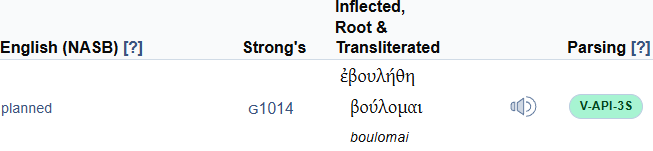
First column shows the word in the English translation. The second column shows you the Strong’s number for the original word (the number is a link and if you click it, you’ll go to the Blue Letter Bible Lexicon – see more in Step 3). The third column shows the original word in the inflected form of the word, the root of the word, and the transliteration of the root. The root is the basic form of the word (here: “plan”), and the inflected form is the form actually used in the text (here: “planned”.) The last column shows you the grammatical explanation of the word, as it appears in the text. You can hover on the letters to show the explanation. Here, V-API-3S stands for: Verb – Aorist Passive Indicative – 3rd Person Singular.
The Strong’s number is a link. If you click it, you’ll go to the Blue Letter Bible’s Lexicon, where you
Step 3: Discover the semantic range
It’s time to discover the range of possible meanings of this particular Greek or Hebrew word. Just like English words, Greek and Hebrew words have a range of meaning that adjusts to fit the intentions of the author or speaker. The goal of this step is to find out this range of meaning. Then you need to find out which of
Use the Lexicon for the word you are studying, as describe in the previous step. There, you will receive lexical information on the word, along with dictionary aids, biblical usage, etc. An entry for each word has eleven parts – you can find an explanation of each of them here. It will allow you to see possible English meanings of the Greek or Hebrew word.
Step 4: Identify the context
Now that you’ve identified the range of the word, you need to categorize all the possible uses by relevancy. The general rule is this: “An author tends to use the same word the same way in the same context.”
The last part of a Lexicon page for each word contains Concordance results for your chosen translation. Categorize the presented uses of the word by the circles of context to the right. The closer a usage is to the text, the more relevance it has. For example, if a word is used five times in the same chapter, those uses are more relevant for understanding the word than say, one use in another book of the NT. You can summarize how the word is used in each of the contexts.

Step 5: Check with the Experts
Now that you’ve done all this foundational work, it’s time to consult what scholars think about how this word is used in this text. There a couple different types of resources that you can consult during this step.
First, study Bibles can often be helpful. Blue Letter Bible includes Bible Study Notes from two Bibles: ESV Global Study Bible and Geneva Bible.
Also, you now have permission to check commentaries. It’s tempting to begin the process with commentaries, but it’s much better to do your own research before you start flipping pages in a commentary. Most commentaries available on Blue Letter Bible deal with specific topic or limited number of biblical passages. There are three commentaries that deal with the whole Bible in more details: Matthew Henry’s, Jamieson, Fausset & Brown’s, and John Trapp’s. Matthew Henry’s is probably the most well regarded of the three. Note: these works are from the 18th/19th century and thus might contain outdated comments.
At this point, you’re looking to see if your particular verse and/or word is treated.
Step 6: Make an informed decision
Now it’s time to make a decision. Based on all of your research, you need to answer two specific questions about this Greek or Hebrew word. First, how do you think the word should be translated? Second, what information from your research provides insight into how the word should be understood?
A couple things to consider when making a decision…
- First, a unique or exotic translation isn’t necessarily the best one. If you come to a conclusion that no one in the course of Christian history has ever thought of before, you might want to reconsider.
- Second, you ultimately want a translation that is true to the author’s intention, in line with how the original audience would have understood the word, and conveys the meaning into the English accurately.
This guide has been adapted to Blue Letter Bible platform and resources from [XXX].